Architecture born from the Amazon: traditional knowledge, forest management and conservation at the Uakari floating lodge
Sleeping over the water in the heart of the Amazon rainforest is more than an experience. It is a genuine way to discover the Mamirauá Reserve with respect, traditional knowledge and sustainability.

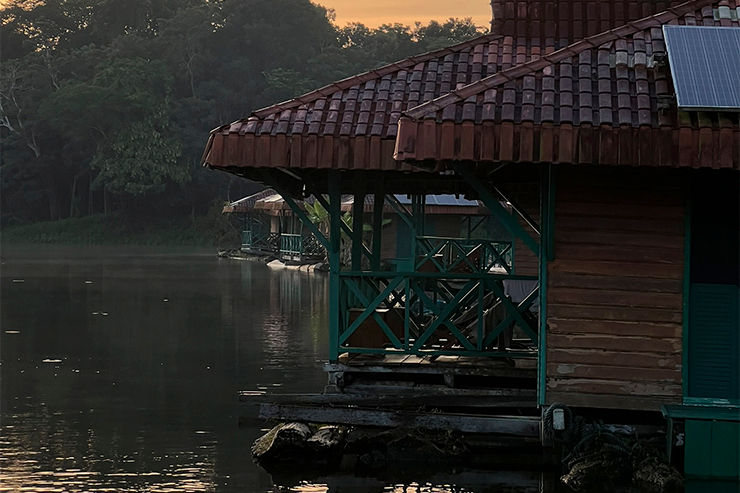
Arriving by speedboat at Uakari Lodge is a gentle transition between river and forest. During the journey from Tefé, about sixty minutes are spent surrounded by water on all sides, trees, branches emerging from the water’s surface, and the constant flight of riverside birds. Suddenly, the landscape changes. The scene is interrupted by five bungalows floating in synchrony with the movement of the water. This is how the lodging experience at the Lodge begins.
Uakari Lodge is located within the Mamirauá Sustainable Development Reserve, in an area known as Lake Mamirauá, connected to the Japurá River, one of the branches of the Solimões River. This location is strategic.
According to Lucas Ramos, operational manager of Uakari Lodge, this is where the lake flows into the river. He explains that it is what they call the current, and that this provides much better wildlife viewing. Fish, river dolphins and caimans gather there to follow their natural dynamics.
Traditional knowledge and science move forward together

The story of the floating Uakari Lodge begins with research. “The lodge started operating in a floating laboratory of the Mamirauá Institute” Lucas recalls. “It was organized in a basic way to receive the first visitors. It was a success, both because of the experience of staying in a floating enterprise and because of its location”.
The experience worked so well that it led to investment in building the current structure. The floating architecture of the lodge was born from the combination of traditional knowledge from Amazonian riverside communities and a commitment to generating less environmental impact in the floodplain.
“People who live in the Amazon already mastered the skill of building large floating structures on the river” Lucas explains. He describes the flooded forest as a mini ecosystem that remains underwater for four or five months each year. The adaptation required by this cycle aligned naturally with techniques for building strong and resilient structures, which already existed long before the lodge and were incorporated into the project.
Building on water reduces environmental impact
When talking about tourism in the Amazon, one of the greatest concerns is interference with the environment. Lucas is straightforward in explaining this choice:
“If we were to build on solid ground, we would need to clear forest, open access, and create a large cleared area to build accommodations. Creating a floating enterprise was more feasible and environmentally responsible.”
Water levels in the Mamirauá Reserve can vary by ten to fifteen meters throughout the year. Floating architecture follows this natural movement without the need for tall, fixed structures anchored to the ground. This avoids large clearings in the forest and reduces changes to the natural routes of fauna and flora.
The result is a floating lodge that is in harmony with the Amazonian landscape.
Assacu: the tree that supports the lodge

The foundation of Uakari Lodge is made of large logs of assacu, a tree native to the Amazon with the scientific name Hura crepitans. This species belongs to the Euphorbiaceae family and occurs mainly in flooded areas, floodplain soils and riverbanks. These trees have grown for centuries adapted to the flood and dry cycles, which makes this wood a natural choice for floating structures.
“They are gigantic trees, over thirty meters tall and extremely thick” , Lucas explains. Assacu wood has a density considered light, which favors buoyancy. Studies by the Brazilian Forest Service indicate an average density between 0.35 and 0.40 grams per cubic centimeter, as well as texture and properties suitable for environments with flowing water.
The morphology of this tree is also remarkable. Assacu produces fruits that open rapidly and spread seeds over a certain distance. The floodplain regime, meaning the flooded forest, helps these floating seeds travel farther each year. This and other mechanisms are closely monitored by the Community Forest Management Group of the Mamirauá Institute, which works alongside riverside communities in continuous training across all aspects of social organization and technical forest management.
Lucas makes a point of distinguishing traditional extraction methods from sustainable management. In the past, the tree was tapped, left to dry, and then cut down. Only then was it removed, when rising water facilitated transportation. Today, the process is technically supervised by the Mamirauá Institute through responsible forest management.
“All the floats of Uakari Lodge have been sourced through managed extraction from the very beginning”, Lucas states. The work is carried out by local communities, with monitoring by researchers. The Mamirauá Reserve covers more than one million hectares with different management programs. Tourism connects directly with this sustainable productive cycle.
Using assacu in the floating architecture of the lodge means building with a species adapted to the environment. Instead of altering the soil or creating large forest clearings, the structure floats on logs that naturally follow changes in water levels. It is a nature based solution grounded in technical and cultural knowledge. It also shows that traditional community knowledge can move alongside conservation, research and sustainable tourism in the Amazon.
A structure that follows the water cycle

Floating requires constant maintenance. The lodge structure is secured with marine cables that need to be adjusted as the river rises or falls. Lucas explains that when water levels rise, the cables must be loosened so the lodge can rise as well. When the river recedes, the cables must be tightened so the lodge can descend.
This is daily work. The maintenance team monitors floor leveling, plumbing, roofing and the natural behavior of the water. The lodge breathes in rhythm with the forest.
Sensations only a floating lodge can offer

Lucas describes one of the most striking moments, which is the arrival:
“You come through this vast expanse of water and forest and suddenly see the structure floating in a romantic way, synchronized with the landscape. Birds fly around, aruanã fish swim nearby. Depending on the season, caimans are living right underneath the lodge.”
There are also the sounds. During part of the year, the current is stronger and the sound of the water feels like a natural soundtrack. Lucas compares it to ASMR, which are soft and repetitive sounds that create a sense of relaxation. It is a constant sensory rest produced by flowing water.
Sleeping over the water is a unique experience. The view is always water or forest. Guests feel as if they are on a vessel with the river in motion, offering a genuine form of immersion in the Amazon.
A floating lodge in harmony with the Mamirauá Reserve

The architecture of Uakari Lodge is not just a visual choice. It represents sustainable tourism integrated with the communities of the Mamirauá Sustainable Development Reserve and aligned with the mission of the Mamirauá Institute.
Bringing together ancestral knowledge, forest management and conservation turns this Amazon rainforest lodge into a reference. It is not about dominating the environment. It is about learning from it.
To learn more about travel to the Mamirauá Reserve, three, four and seven night itineraries, and wildlife observation experiences, visit the official website: