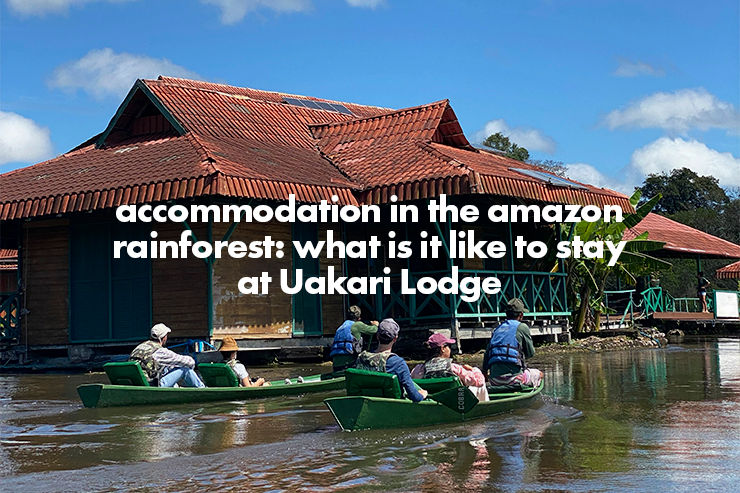
Floating Lodge in the Amazon: How Uakari Lodge Works
Find out how a floating lodge in the Mamirauá Reserve operates, from transportation and sanitation to maintenance, accommodation, and excursions

A floating lodge in the Mamirauá Reserve operates on the water and must adapt to changes in river levels. At Uakari Lodge, this involves anchoring systems, wastewater and waste management, structural maintenance, boat transportation, and excursion planning.
Located in the Mamirauá Sustainable Development Reserve, in the Brazilian state of Amazonas, Uakari Lodge has been operating for 26 years, adapting to the conditions of the flooded rainforest. Daily operations range from adjusting mooring lines as water levels change to arranging guest transfers from Tefé.
Accommodation that rises and falls with the river

Uakari Lodge has 10 rooms distributed across five floating bungalows, each with two rooms and private bathrooms. This limits capacity to around 20 guests at a time. Building on the water rather than clearing land for a conventional structure also avoided the deforestation and clearings that a fixed building would have required.
The bungalows rest on logs of assacu, a tree native to flooded areas of the Amazon whose wood is light enough to float. According to studies by the Brazilian Forest Service, its average density ranges from 0.35 to 0.40 grams per cubic centimeter. The logs are sourced through forest management carried out by communities in the reserve, with technical support from the Mamirauá Institute.
Water levels in the reserve can vary by 10 to 15 meters throughout the year. The lodge was therefore designed to rise and fall with the river, without relying on fixed foundations in the ground.
Sanitation within a protected area
Within a protected area, improper waste and sewage disposal can compromise water quality, threaten the health of riverside communities, and harm local wildlife. For this reason, the lodge has wastewater treatment systems and a selective waste collection program.
These measures also contribute to safety by helping prevent animals from approaching the facilities. Solar energy supplies the lodge's main operations, reducing noise and dependence on fossil fuels. Together, these measures help ensure that accommodating up to 20 guests at a time remains compatible with the flooded rainforest environment.
Read also: Plants with Traditional Uses in the Amazon: How Communities Use Forest Species in Everyday Life
Daily maintenance at Uakari Lodge
The lodge is secured by marine-grade mooring lines that must be adjusted as the river level changes. According to Lucas Ramos, Uakari Lodge's operations manager, the lines are loosened when the water rises, allowing the lodge to rise with it. When the river level drops, the lines are tightened to allow the structure to descend.
These adjustments are made daily, alongside inspections of floor alignment, plumbing, roofing, and protective screens. The maintenance team, made up of residents of the reserve, checks each of these elements individually.
How to get to the Mamirauá Reserve

Getting to Uakari Lodge begins in Tefé, a town in the interior of Amazonas that serves as the gateway to the Mamirauá Reserve. From there, the journey continues by speedboat for approximately one hour, passing through Lake Tefé, the Solimões River, one of the channels of the Japurá River, and finally Lake Mamirauá. Azul Linhas Aéreas operates flights between Manaus and Tefé.
Because flights between Manaus and Tefé do not operate daily and follow fixed schedules, the lodge organizes check-ins and check-outs on Tuesdays and Saturdays. The team welcomes guests at the airport, monitors flights to adjust transfers in case of delays, and includes round-trip transportation in the accommodation package. Communication with Tefé also ensures support in the event of a medical emergency.
Uakari Lodge excursions during the high-water and low-water seasons

Excursions follow the same principle of adapting to the water cycle. During the high-water season, forest trails are flooded, and visitors travel by canoe near the treetops. During the low-water season, forest trails become accessible on foot.
To accommodate these changing conditions, the lodge alternates between traditional paddle canoes, whose quiet movement makes wildlife observation easier, and motorized boats, which are used for longer distances. Every activity, from nighttime alligator spotting to visits to riverside communities, follows established protocols, with certified guides and carefully managed group sizes.
Residents of the Mamirauá Reserve on the Uakari Lodge team

More than 90% of Uakari Lodge's team, including managers, guides, cooks, boat operators, and maintenance professionals, consists of residents of the surrounding region. Their work is organized through the Association of Ecotourism Assistants and Guides of Mamirauá (AAGEMAM), established by local residents themselves.
The association follows a rotating work system that distributes employment and income opportunities among different families while allowing professionals to maintain their ties to activities in their communities.
The lodge is managed in partnership with the Mamirauá Institute and the communities of the Mamirauá Reserve, with AAGEMAM involved in organizing and delivering services. This team carries out the many tasks required to keep the lodge running, from welcoming guests to handling maintenance, transportation, and excursions.
Come discover the Mamirauá Reserve and Uakari Lodge. Experience what it is like to spend the night in a floating lodge, surrounded by the Amazon rainforest. Whatever the season, the forest is waiting for you.
Follow Uakari on Instagram to keep up with the latest news. Ready to experience it for yourself? Make your reservation.