How Fishing Works in the Mamirauá Reserve: Management and Tradition
Discover how fishing works in the Mamirauá Sustainable Development Reserve, from the management of pirarucu to the fish served at the table and the traditional fishing experiences at Uakari Lodge

How fishing works in the Mamirauá Reserve: management, food, and way of life

Today, fishing in the Mamirauá Sustainable Development Reserve is based primarily on the community-led management of pirarucu. Riverside communities visually count fish stocks in each lake, the Mamirauá Institute compiles and organizes this data, and submits it to IBAMA, which authorizes an annual harvest quota of up to 30% of the recorded adult population. The remaining fish are left untouched to ensure the species can reproduce in the following year.
This same system, built over nearly three decades, shapes much of what is served on the menu at lodges such as Uakari Lodge and defines how guests experience traditional fishing within the reserve. Understanding how it works requires looking back to the moment when pirarucu fishing was on the verge of disappearing.
From ban to recovery: the origins of pirarucu management

The pirarucu (Arapaima gigas), the world's largest freshwater scaled fish, was added to the list of endangered species in 1996 after decades of overfishing across the Amazon. The initial response was restrictive. Commercial fishing of the species was banned, and the fish became the focus of research by the Mamirauá Institute, which had been working in the reserve since its establishment in 1996 as Brazil's first Sustainable Development Reserve.
However, the ban alone was not enough because it failed to answer a fundamental question: how could illegal fishing be prevented across more than 1.1 million hectares of flooded forest crossed by hundreds of lakes without turning the local riverside population into both inspectors and permanent suspects?
The solution emerged in 1999 in the community of São Raimundo do Jarauá by reversing that logic. Instead of relying on external enforcement, participatory management transferred responsibility to the communities themselves, allowing them to count fish populations, protect the lakes, and determine who could fish and how much could be harvested.
How the management system works, step by step

The counting method is based on a unique biological characteristic of the pirarucu. The species has two respiratory systems, one through gills and another through an air-breathing organ, which means it must surface every 15 to 20 minutes to breathe.
Fishers trained by the Mamirauá Institute's Fisheries Research Group, in partnership with organizations such as the National Institute for Amazonian Research (INPA), use these regular surfacing events to visually estimate, lake by lake, how many adult fish are present at that moment.
Once the count is completed, the community submits the figures to IBAMA, the federal agency responsible for authorizing fishing and defining the annual harvest quota. The approved quota may represent no more than 30% of the recorded adult population. The remaining 70% stay in the lakes, ensuring a healthy breeding stock for the following year.
Only after this authorization is granted does the fishing season begin. The harvest takes place collectively over a few days, with the entire community participating in catching, transporting, and later marketing the fish. The profits are then shared among all participants.
The results: fishers, income, and recovered fish stocks

Nearly three decades after the program began, the Mamirauá Institute has recorded an increase of approximately 620% in the natural pirarucu population within the reserve's managed areas. More than 1,165 fishers have participated in the program over the years. The model has since expanded to other regions of the state of Amazonas and is now internationally recognized as one of the world's best documented examples of fish stock recovery through community-based management.
What makes this system successful is not simply the harvest quota itself, but the fact that it is established by the communities. This changes the incentive behind enforcement. Protecting the lakes from illegal fishing is no longer an external obligation but a direct way of safeguarding the community's own source of food and income.
From floodplain to plate: the fish that sustains Uakari Lodge

This management system has a direct impact on what is served at Uakari Lodge. Sustainably managed pirarucu, thanks to its traceable origin and harvesting process that follows sanitary regulations, represents the legal and sustainable alternative to a fish that, decades ago, was available almost exclusively through illegal fishing.
Alongside pirarucu, tambaqui, the second largest scaled fish in the Amazon Basin, also appears frequently on the lodge's menu. It is prepared using traditional cooking techniques passed down through the riverside communities whose residents cook for guests.
Eating pirarucu or tambaqui during your stay is therefore more than a culinary experience. It is part of the same chain that begins with counting fish populations in the lakes and ends in the lodge's kitchen. The difference is that guests enjoy the direct outcome of a conservation system that is actively protecting the Amazon rather than exploiting it.
Fishing, farming, and tourism: the way of life of riverside communities

For the families who live within and around the Mamirauá Sustainable Development Reserve, fishing has never been an isolated activity. In communities such as Caburini, Boca do Mamirauá, and Vila de São José, residents alternate between fishing, floodplain agriculture, and tourism, moving between these three livelihoods according to the annual flood cycle and the needs of each season.
More than 90% of Uakari Lodge's staff come from these communities. This means that the boat driver leading a morning excursion and the cook preparing fish with tucupi for lunch both carry the same practical knowledge of the lakes that supports the sustainable management of pirarucu.
The connection between fishing, food, and tourism also has an economic impact. In 2024 alone, the communities received more than half a million reais in direct benefits generated by the lodge's operations. Part of these resources comes from the Socio-Environmental Support Fee included in every stay, complementing the income already generated through sustainable fisheries management.
To learn more about these families and how life is organized within the reserve, read our article about the Amazon's riverside communities on the Uakari Lodge blog.
Traditional fishing at Uakari Lodge

Guests staying at Uakari Lodge can experience the region's fishing traditions firsthand, always accompanied by local guides and tailored to their chosen itinerary.
Traditional piranha fishing, included in the 4 and 7-night itineraries, safely guided by experienced riverside guides.
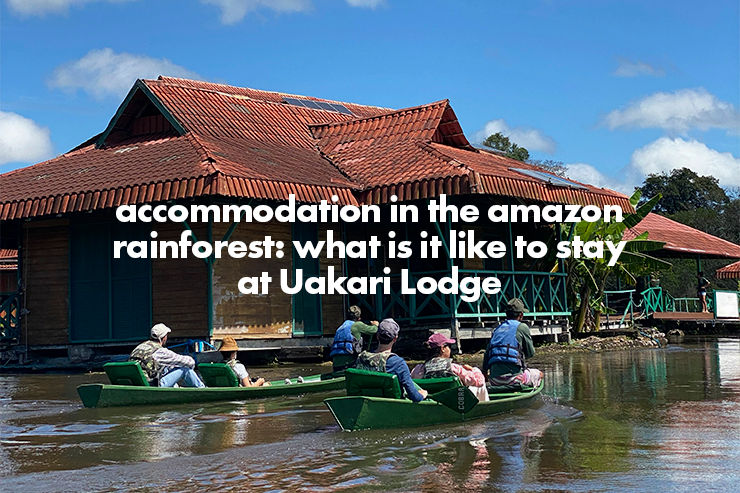
Canoe excursions through flooded forests and narrow channels, where guests may spot silver arowanas leaping near the banks and schools of piranhas moving among submerged roots.
Conversations with researchers from the Mamirauá Institute, who work just a few kilometers from the lodge and provide firsthand insights into the pirarucu management system.
The lodge's own menu, where pirarucu and tambaqui are prepared using traditional recipes and cooking techniques from local riverside communities.
None of these experiences exists in isolation. They are all part of a broader approach developed by Uakari Lodge and the Mamirauá Institute, where exploring the reserve also means understanding why fishing follows such specific rules. Rather than limiting the visitor's experience, these rules are precisely what ensure that the fish guests observe and enjoy during their stay continue to thrive in the reserve.
To explore all available itineraries and activities, visit the Uakari Lodge Experiences page.
Follow Uakari Lodge on Instagram to stay connected with daily life in the reserve, and book your stay to experience the Amazon firsthand.