
Nocturnal Animals of the Mamirauá Reserve: A Complete Guide to Night Spotting
Learn about the nocturnal animals of the Mamirauá Reserve, such as the black caiman, the jaguar and the margay, and see how to observe them during Uakari Lodge's night spotting excursions.
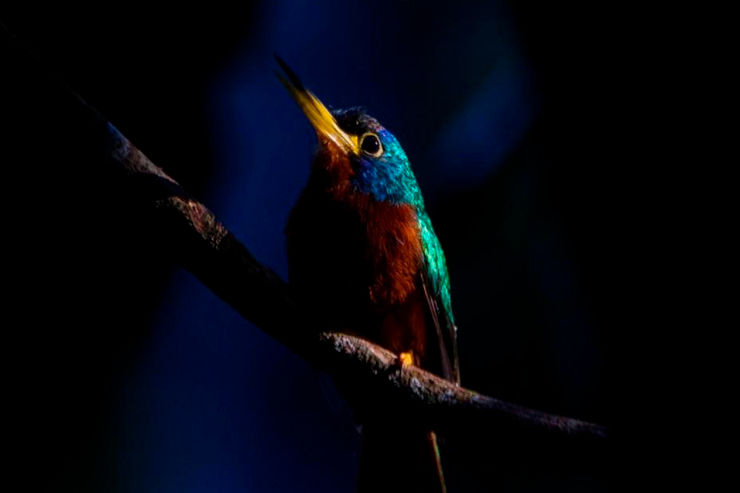
The Mamirauá Reserve is home to several nocturnal species, among them the black caiman (Melanosuchus niger), the jaguar (Panthera onca), the margay (Leopardus wiedii) and the paca (Cuniculus paca), animals that use the darkness of the flooded forest to hunt, camouflage themselves or avoid predators. Most of them can be observed during the night spotting excursions offered by Uakari Lodge, within the reserve itself.
Located in the heart of Amazonas, between the Solimões and Japurá rivers, the Mamirauá Sustainable Development Reserve is the largest protected várzea area in the world, and the forest that floods and dries throughout the year creates particular conditions for many species to concentrate their activity after the sun sets, when the temperature drops, competition for food decreases and some predators become less present.
Black Caiman: The Predator Living Beneath the Lodge

The black caiman is the largest aquatic predator in Latin America, with males that can exceed 6 meters in length, and it lives in the rivers and lakes of the Mamirauá Reserve, where the Mamirauá Institute has carried out scientific captures of the species since 2004 to monitor the structure of the population over the years. According to biologist Gustavo Figueirôa, a specialist in Wildlife Management and Conservation, the black caiman's dark coloring works as camouflage in the murky waters of the region, particularly at night, which makes the animal practically invisible to its prey until it is too late.
At Uakari Lodge, this proximity to the black caiman is not a metaphor. The lodge floats on large assacu logs, and caimans commonly live quietly just beneath the floating structures, depending on the time of year. During the canoe night spotting excursions, local guides use spotlights to locate the animal's eyes reflecting on the dark surface of the river, a technique also used by the reserve's own researchers in their surveys.
Jaguar: Between Dusk, Night and Morning

The jaguar is generally described as a crepuscular and nocturnal animal, but a study conducted by the Mamirauá Institute for Sustainable Development, specifically at Lake Mamirauá, found a different pattern: the jaguars in the region show activity distributed throughout the day, being more active in the morning and less active at night. Researchers attribute this behavior to the fact that the jaguars' main prey in the reserve is precisely the caiman, an animal of predominantly nocturnal habits, which may make hunting more efficient during the day, when caimans are less active. The full study on the species' population dynamics at Lake Mamirauá is available here.
This predator-prey relationship is one of the clearest examples of how nocturnal habits, in the Amazon, are not an isolated trait of each species, but part of a network of behaviors that adjust to one another.
Margay: The Feline That Hunts in the Flooded Forest Canopy

Among the small wild felines of the Brazilian Amazon, the margay is the one that inhabits the Mamirauá Reserve, adapted to living in the trees during the flood season, according to a report published by the Mongabay website based on research by the Mamirauá Institute. The species has nocturnal and arboreal habits, and spends much of its time hunting birds and small mammals in the treetops, as described by wildlife conservation organizations such as Pró-Carnívoros and Apremavi. Being a solitary, rare animal that is difficult to spot, seeing a margay in the wild tends to depend on luck and on good guides, even during night excursions.
Paca and Sloth: Other Residents of the Night in Mamirauá
The paca is described by the Mamirauá Institute as a nocturnal rodent with an important role in the diet of Amazonian populations, and a doctoral thesis on wild game hunting patterns in the Mamirauá and Amanã Reserves confirms the presence of the species in both conservation units managed by the institute.
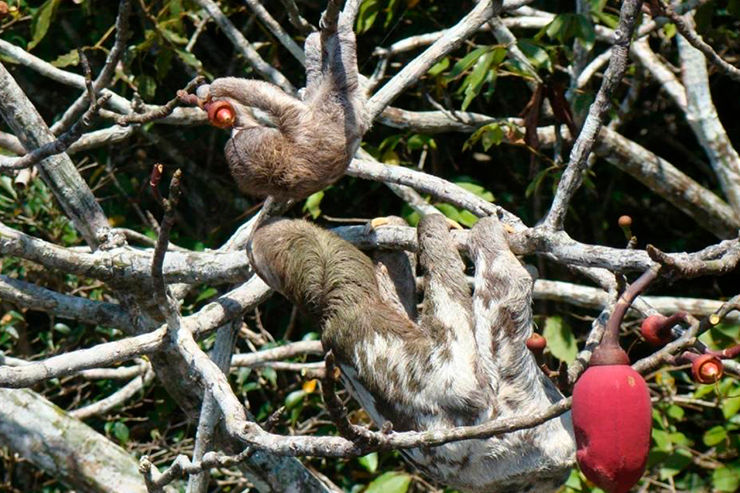
The sloth, despite its reputation as a slow and discreet animal, can be active both at night and during the day, although it spends most of the day resting, motionless in the treetops. A wildlife survey using camera traps in the Mamirauá Reserve, conducted by the Mamirauá Institute, records frequent sightings of the animal feeding in embaúba and munguba trees in the reserve's várzea forests, and points to the sloth as one of the main prey of jaguars in the area.
How to Observe the Nocturnal Animals of the Mamirauá Reserve at Uakari Lodge
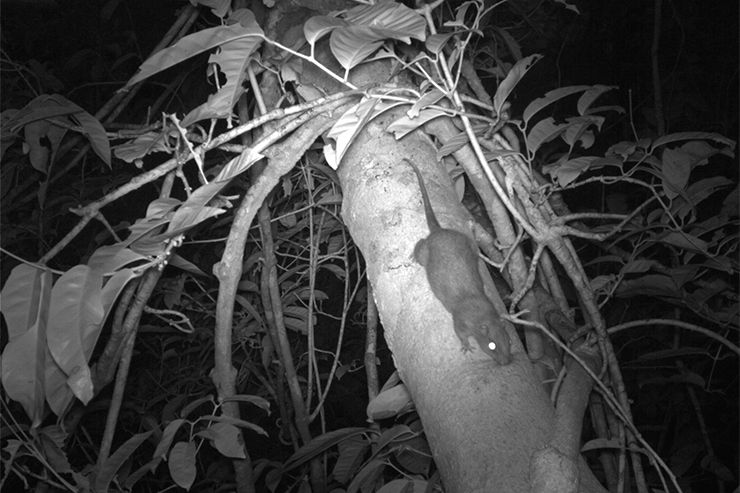
At Uakari Lodge, the forest's nocturnal life is part of the itinerary from the shortest stay onward. On the 3-night itinerary, the night caiman spotting excursion is already included, done by canoe through the channels near the lodge, with local guides who know the spots where caimans tend to gather in each season. On the 4-night itinerary, this experience deepens with a night trail adapted to the time of year, increasing the chances of encountering other animals that only appear after dark. The 7-night itinerary includes the installation of camera traps, and the Mamirauá Institute's own researchers usually present the images captured throughout the week to guests on the last night, many of them showing species that would rarely be seen with the naked eye.
This combination of scientific research and community-based tourism is what sets the experience at Uakari Lodge apart, because every night excursion carries, alongside the observation of wildlife, the knowledge accumulated over decades of study within the Mamirauá Reserve itself.
To learn about the 3, 4 and 7-night itineraries and plan your stay at Uakari Lodge, visit our website and follow our Instagram profile for updates straight from the forest.


