Traveling Solo to the Amazon: A Guide for Those Visiting Uakari Lodge on Their Own
Uakari Lodge welcomes solo travelers to the Amazon. Private rooms, small groups, and local guides make the experience complete, with or without company

Is Uakari Lodge suitable for solo travelers? Yes. The lodge operates with groups of up to 24 guests, shared meals, and a structured program led by local guides. All accommodations are private, and no guest shares a room with strangers. Transfers, meals, and activities are included in the daily rate, which answers most concerns of travelers arriving alone. What changes for solo travelers is not the structure itself, but what they do with it, because without an established social dynamic, there is a tendency to open up more to the territory, the guides, and the people encountered along the way.
There is a moment, during the first dinner at Uakari Lodge, when something happens without anyone planning it. The table is shared, the river flows just a few feet below the floating structures, and conversations unfold naturally among people who already shared a full day in the forest, even if it was their very first one. Researchers from the Mamirauá Institute talk about the white uakaris spotted that morning. The guide explains why pink river dolphins appear more frequently in a certain channel during high water season. Someone, still energized from the night caiman spotting excursion, describes the animal’s eyes reflecting the spotlight across the dark river surface.
Those who arrive alone do not usually feel the absence of company in that moment. More often, they feel an openness that rarely exists when traveling with someone they already know well.
This is not a sentimental observation. There is something about the structure of solo travel that changes the traveler’s relationship with the place. Without a fixed point of reference, people tend to turn outward, toward the researchers leading each experience, the other guests sharing meals and canoe rides, and the residents of the communities visited throughout the stay. Uakari Lodge, through its scale and operational model, enhances this condition rather than neutralizing it.
Questions that arise before booking the trip to Amazon

Quem considera viajar sozinho para a Amazônia raramente tem dúvidas sobre o destino. A Reserva de Desenvolvimento Sustentável Mamirauá, reconhecida pela UNESCO como Patrimônio Natural da Humanidade, dispensa apresentações como ecossistema.
People considering traveling solo to the Amazon rarely hesitate because of the destination itself. The Mamirauá Sustainable Development Reserve, recognized by UNESCO as a Natural World Heritage site, speaks for itself as an ecosystem. What creates hesitation is something else: the experience itself.
“Will I feel out of place among groups that already know each other?” “Is the logistics too complicated for someone traveling alone?” “Are the rooms shared with strangers?”
These are common questions solo travelers ask, and they deserve direct answers.
Uakari Lodge operates with groups of up to 24 guests. Meals are shared at communal tables, which means social interaction begins with the first lunch after check-in and continues through dinner on the final evening. Every activity, whether navigating flooded forest channels, interpretive walks through várzea forest, night caiman spotting, meeting researchers from the Mamirauá Institute, or visiting riverside communities, is guided by people who know the territory intimately.
As for accommodations, there are ten apartments in total, all private, each with a window facing the river. Privacy is guaranteed and so is connection. The two coexist naturally.
The scale that turns strangers into company

With groups that never exceed 24 people, Uakari Lodge does not create anonymity. After two days of shared activities, everyone usually knows each other’s names, where they came from, and what brought them to that part of the Amazon.
This happens less because of social effort and more because the experiences demand collective attention. When the canoe stops in the middle of the flooded forest and the guide silently points to a white uakari high in the trees above the water, the reaction is rarely individual. The entire group holds their breath together. When a Mamirauá Institute researcher presents images captured by camera traps on the final night, everyone feels invested in the same result.
The forest quickly creates a shared language. Not because it is magical, but because what it offers is intense enough that differences in background, profession, and personal history lose importance compared to what is happening outside the window.
For solo travelers, this dynamic has a particular effect. Without a fixed conversation partner, attention becomes more focused and more often directed toward guides, researchers, fellow guests, and riverside residents. The territory becomes easier to absorb when there is no preexisting relationship filtering the experience.
Benjamino Pederzolli, sustainability manager at an Italian company who visited Uakari Lodge, described his experience this way: “The greatest insight I took from this experience was realizing that there are multiple ways to understand what a society is and how it relates to nature”.
This openness does not depend on arriving with company. It is not by chance that studies on solo traveler behavior indicate that the greatest fear before departure is loneliness, while what people actually report after a solo trip is almost the opposite: less isolation than at home and more genuine contact with people they meet along the way. The absence of a fixed social shield, which protects but also isolates, creates space for conversations that would rarely happen otherwise.
What the lodge structure offers
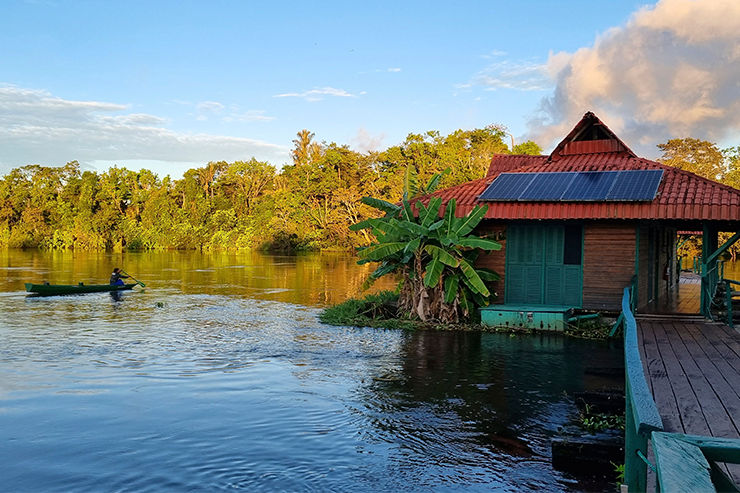
The hesitation of those planning to travel alone rarely has anything to do with courage. It has more to do with organization: how to coordinate transfers in unfamiliar territory, what to do at each moment of the day, and how not to waste time in a destination that depends on specific logistics.
At Uakari Lodge, most of these variables are resolved before arrival.
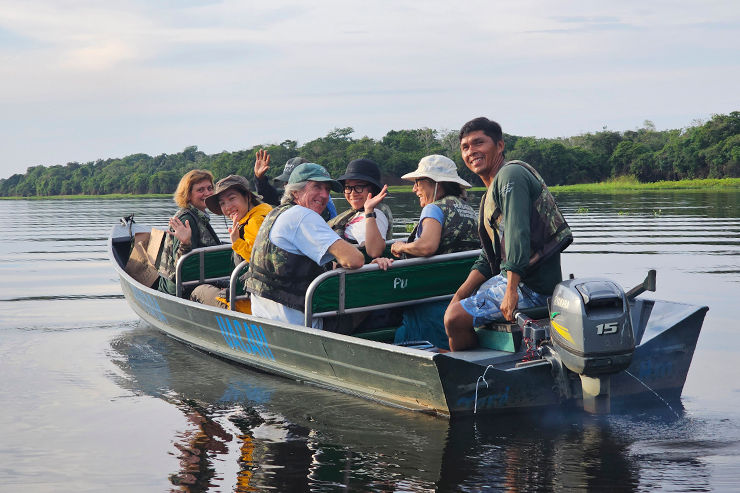
Itineraries have fixed check-in and check-out dates, always on Tuesdays and Fridays. Transfers from Tefé airport to the port are included, as is the boat journey up the Solimões River for about an hour and a half to reach the lodge. Meals are fully included and prepared with fresh regional ingredients.
Each outing includes a local guide, someone who knows every channel, trail, and species with the precision of someone who was born and raised inside the reserve. For solo travelers, the main task is simply arriving in Tefé. This does not remove spontaneity, but it eliminates the anxiety of navigating alone in a place where geography demands constant guidance.
There is enough structure for every day to have direction, and enough freedom for each guest to find their own rhythm within it. Those who want to go deeper into a trail or continue a conversation with a biologist have room to do so. Those who prefer spending the afternoon on the veranda watching the river flow below can do that too.
The importance of each visit

There is a dimension of traveling to Uakari Lodge that rarely appears in planning calculations: the direct impact each stay creates for the riverside communities of the Mamirauá Reserve.
The lodge is managed in partnership with the Mamirauá Institute and the Association of Ecotourism Assistants and Guides of Mamirauá (AAGEMAM).
More than 90% of staff members come from the region, including guides, cooks, boat operators, and maintenance teams. A rotating work system distributes employment and income among different families throughout the year. The Socioenvironmental Support Fee included in the daily rate finances initiatives ranging from community transportation boats to communication centers and radio systems.
In 2025, community-based ecotourism revenue in the reserve reached its highest level in the last four years: R$ 607,000 generated by AAGEMAM, plus R$ 36,000 collected through the Socioenvironmental Fee.
A solo traveler contributes no less to this equation. Every stay supports the same cycle, regardless of how many people arrive together.
What changes for those arriving alone

The experience at Uakari Lodge was not specifically designed for solo travelers, and perhaps that is exactly why it works so well for them. A model based on small groups immersed collectively inside an environmental reserve, with structured activities, private rooms, and local guides for every excursion, creates conditions that naturally fit this profile.
No one becomes invisible in a group of 24 people. No one explores flooded channels or night trails without guidance from those who truly know the territory.

What changes for those arriving alone is mostly availability. Without an already established social dynamic, people tend to pay closer attention to the guide, ask questions that might not arise otherwise, and spend more time observing what is in front of them rather than commenting on it with someone else.
The Amazon does not reveal itself in a hurry, and those without a prearranged rhythm with another person often move at exactly the pace the place asks for: slow, attentive, and open to whatever appears.

The Mamirauá Reserve, with its water cycle that fluctuates by the equivalent of a four-story building throughout the year and completely reshapes the landscape and visitation routes, is exactly the kind of destination this traveler profile seeks.
The Mamirauá Reserve existed long before any lodge.
Uakari Lodge was created so that it can continue to be what it is and so that more people can experience it without leaving marks on the ecosystem. Having company is optional. Being present is not.
Come discover the Mamirauá Reserve and Uakari Lodge. Experience what it feels like to sleep in floating accommodations. In every season, the Amazon rainforest awaits you.
Follow Uakari on Instagram and stay updated with the latest news. Ready to live this experience? Make your reservation.